
Homelessness is one of those issues that reveals exactly what a city values.
Not in its speeches. Not in its mission statements. But in its budget lines, its partnerships, its willingness to sit with uncomfortable realities, and its commitment to doing the hard, unsexy, long-term work of actually solving the problem instead of just managing it.
Fairfield, California is at a crossroads on this issue. The need is visible. The urgency is real. And the question of how the city responds, with genuine strategy or with politics dressed up as compassion, will shape District 1 and the broader community for years to come.
K. Patrice Williams has a clear answer to that question. It starts with seeing people as people. It is held together by accountability and measurable results. And it is built on the kind of coordinated, community-rooted approach that actually moves the needle instead of just checking boxes.
Here is what that looks like in practice.
Why Homelessness Requires a Compassionate Response
Before the policy, before the programs, before the data, there is a person.
That is where K. Patrice Williams always starts.
Homelessness in Fairfield does not have one face or one story. It is the veteran who came home from service carrying wounds that nobody could see and slowly lost his footing. Likewise, it is the family that was one medical emergency away from eviction and did not have a safety net to catch them. It is the young woman who aged out of foster care with nowhere to go and no one to call. Also, it is the senior citizen on a fixed income who got priced out of a rental she had lived in for fifteen years.
These are not abstractions. They are neighbors. And how a city treats its most vulnerable residents says everything about its character.
Patrice approaches homelessness from a place of genuine humanity, shaped in part by her own story. She has navigated personal loss and financial hardship. She understands, not academically but personally, how quickly circumstances can shift and how much it matters to have systems of support that actually work when you need them.
That personal grounding shapes everything about her approach:
- She refuses to reduce homeless individuals to a statistic or a nuisance to be managed
- She believes that dignity is non-negotiable in every interaction between city services and unhoused residents
- She understands that most people experiencing homelessness are not there by choice and that judgment is not a strategy
- She recognizes that the path out of homelessness looks different for every person and that cookie-cutter solutions leave too many people behind
Compassion is not softness. It is clarity. It means seeing people clearly enough to actually help them. And it is the foundation on which every other element of Patrice’s homelessness strategy is built.
Accountability: Ensuring Programs Deliver Measurable Results
Compassion without accountability is just good intentions.
And good intentions, as anyone who has worked in public policy knows, do not automatically translate into good outcomes. Cities across California have spent significant resources on homelessness programs that produced impressive press releases and disappointing results. Fairfield cannot afford to repeat that pattern, financially or morally.
K. Patrice Williams is uncompromising on this point. Every program the city funds, every partnership it enters into, every initiative it launches in response to homelessness must be held to a clear standard of measurable outcomes.
What does accountability look like in this context?
- Clear metrics from the start: Before a program receives city support, there should be defined, measurable goals. How many people will be served? What does successful placement look like? What is the target timeline? Vague goals produce vague results.
- Regular public reporting: Fairfield residents who are funding these programs through their tax dollars deserve to know whether those programs are working. Patrice supports transparent, regular reporting on homelessness initiatives that goes beyond annual summaries and reflects real-time progress.
- Honest evaluation of what is not working: This is the part most politicians avoid. When a program underperforms, the politically safe move is to quietly redirect funding and hope nobody notices. Patrice’s approach is different. If something is not delivering results, say so, understand why, adjust, and move forward with better information.
- Resource allocation that follows evidence. Funding decisions should be driven by data on what is actually reducing homelessness, not by which programs have the loudest advocates or the longest history. Evidence-based allocation is both more ethical and more effective.
- Long-term tracking of outcomes. Getting someone off the street is a beginning, not an ending. Accountability means tracking whether people remain housed six months later, one year later, three years later. Sustainable exits from homelessness, not temporary placements, are the real measure of success.

The Role of Non-Profits Like Solano Impact Care and Empower Solano
No city government solves homelessness alone.
The most effective approaches to homelessness in cities across the country share one common feature: genuine coordination between government, nonprofit organizations, healthcare providers, faith communities, and social service agencies. Not parallel efforts running on separate tracks. Actual coordination, with shared data, shared goals, and shared accountability.
Fairfield has assets in this space that are worth building on.
Organizations like Solano Impact Care and Empower Solano are doing critical work in the community. They have the trust of the people they serve, the expertise that comes from years of frontline experience, and the flexibility that nonprofit organizations can bring that government agencies sometimes cannot. In addition, they are not peripheral to the solution. They are central to it.
K. Patrice Williams sees her role as a council member in this ecosystem clearly:
- Strengthening the city’s partnerships with organizations like Solano Impact Care and Empower Solano rather than treating them as vendors to be managed or competitors to be wary of
- Ensuring these organizations have the resources they need to do their work effectively, including stable funding streams that allow for long-term planning rather than year-to-year uncertainty
- Creating formal coordination structures so that the city, county agencies, and nonprofit partners are working from a shared understanding of the problem, a shared set of data, and a shared accountability framework
- Removing bureaucratic barriers that make it harder for effective organizations to serve the people who need them most
- Elevating the expertise of frontline workers who understand the realities of homelessness in Fairfield better than any city council member or administrator and whose insights should be informing policy decisions
The coordinated care model works when everyone in the system is genuinely aligned around the same goal: getting people housed, keeping them housed, and addressing the underlying challenges that led to homelessness in the first place. Patrice is committed to building and sustaining that alignment in Fairfield.
Examples of Effective Housing and Support Initiatives
Cities and counties that have taken a coordinated, accountable, compassionate approach have produced real results. These are not perfect solutions, because this is a complex problem without perfect answers. But they are proof that the right strategies, implemented with consistency and commitment, actually work.
Here are the models and approaches that inform Patrice’s vision for Fairfield:
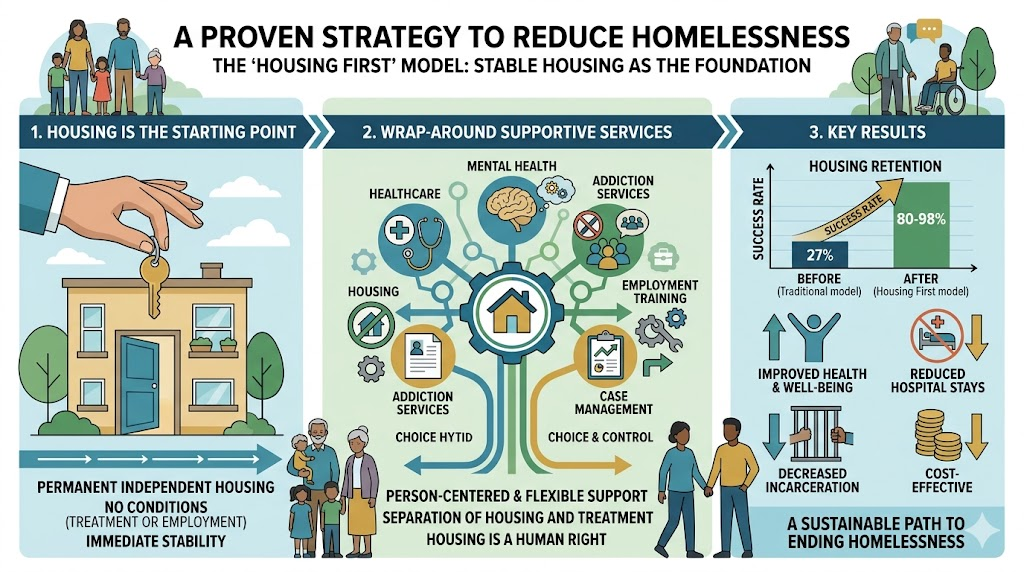
Housing First
The evidence on Housing First is strong and consistent. When people are placed in stable housing without preconditions, their ability to address the other challenges in their lives, mental health, substance use, employment, dramatically improves. Fairfield’s approach to homelessness should be anchored in this model, with supportive services wrapped around stable housing rather than made a prerequisite for it.
Rapid Rehousing Programs
Short-term rental assistance paired with case management has proven effective at moving people out of homelessness quickly and helping them maintain stability. Cities that have invested in rapid rehousing have seen significant reductions in shelter populations and long-term homelessness rates. This is a model Fairfield should be scaling aggressively.
Navigation Centers
Unlike traditional shelters, navigation centers provide a lower-barrier entry point with on-site services designed to move people quickly into permanent housing. They have shown strong results in cities that have implemented them thoughtfully and with adequate wraparound support.
Veteran-specific programs
The VA and its community partners have developed effective models for addressing veteran homelessness that combine housing assistance with specialized mental health and substance use services. Given Fairfield’s proximity to Travis Air Force Base, the city has both a particular responsibility and a particular opportunity to invest in veteran-focused homelessness solutions.
Peer support programs
Some of the most effective voices in homelessness prevention and recovery are people who have experienced it themselves. Programs that train and employ people with lived experience of homelessness as peer navigators and support workers have shown strong outcomes and create meaningful employment pathways at the same time.
These are not distant examples. They are proven approaches that can be adapted and scaled to fit Fairfield’s specific context, community relationships, and available resources. Patrice is committed to bringing this evidence base directly into Fairfield’s homelessness strategy.
The Path Forward
Knowing what works is only valuable if you actually scale it.
That is the gap where too many cities get stuck. They pilot a promising program, see early results, and then leave it underfunded and under-resourced while the broader problem continues to grow. Patrice is committed to closing that gap in Fairfield.
Her vision for scaling Fairfield’s homelessness response includes:
- Expanding rapid rehousing capacity by securing additional state and federal funding and deepening partnerships with nonprofit housing providers who can move quickly when resources are available
- Developing more permanent supportive housing units in Fairfield so that the people who need the most intensive support have a place to land that is both stable and equipped with the services they need
- Building a real-time data system that tracks homelessness across Fairfield and connects all partner organizations so that resources can be deployed where they are needed most, without duplication or gaps
- Investing in prevention because keeping people housed is significantly less expensive and less traumatic than helping them recover from homelessness. Targeted rental assistance, eviction prevention programs, and early intervention can stop people from falling into homelessness in the first place
- Advocating at the state level for the funding and policy support that Fairfield needs but cannot generate locally on its own. California has significant resources dedicated to homelessness and Patrice is committed to ensuring Fairfield is competitive for every dollar available
- Engaging the broader community because homelessness cannot be solved by government alone. Faith communities, businesses, neighborhood associations, and individual residents all have a role to play and Patrice believes in building a community-wide response that reflects Fairfield’s values
Fairfield Can Do Better. K. Patrice Williams Is Ready to Lead the Way.
Reducing homelessness in Fairfield is not a simple task. Anyone who tells you otherwise is not being straight with you.
But it is absolutely possible. With the right combination of compassion and accountability. Also, with genuine coordination between city government and the nonprofit partners who are already doing critical work. With evidence-based strategies scaled to meet the real scope of the need. And with leadership that is willing to stay focused on outcomes even when it is hard.
K. Patrice Williams has spent four years building the relationships, the knowledge, and the credibility to lead this work in a second term. She is not starting from scratch. She is building on a foundation that is already in place and pushing it further, faster, and with greater impact.
Fairfield’s unhoused residents deserve nothing less. And neither do the neighborhoods, families, and communities working alongside them every day.
This November, vote K. Patrice Williams for Fairfield City Council, District 1.
Learn more at kpatriceforfairfield.com