
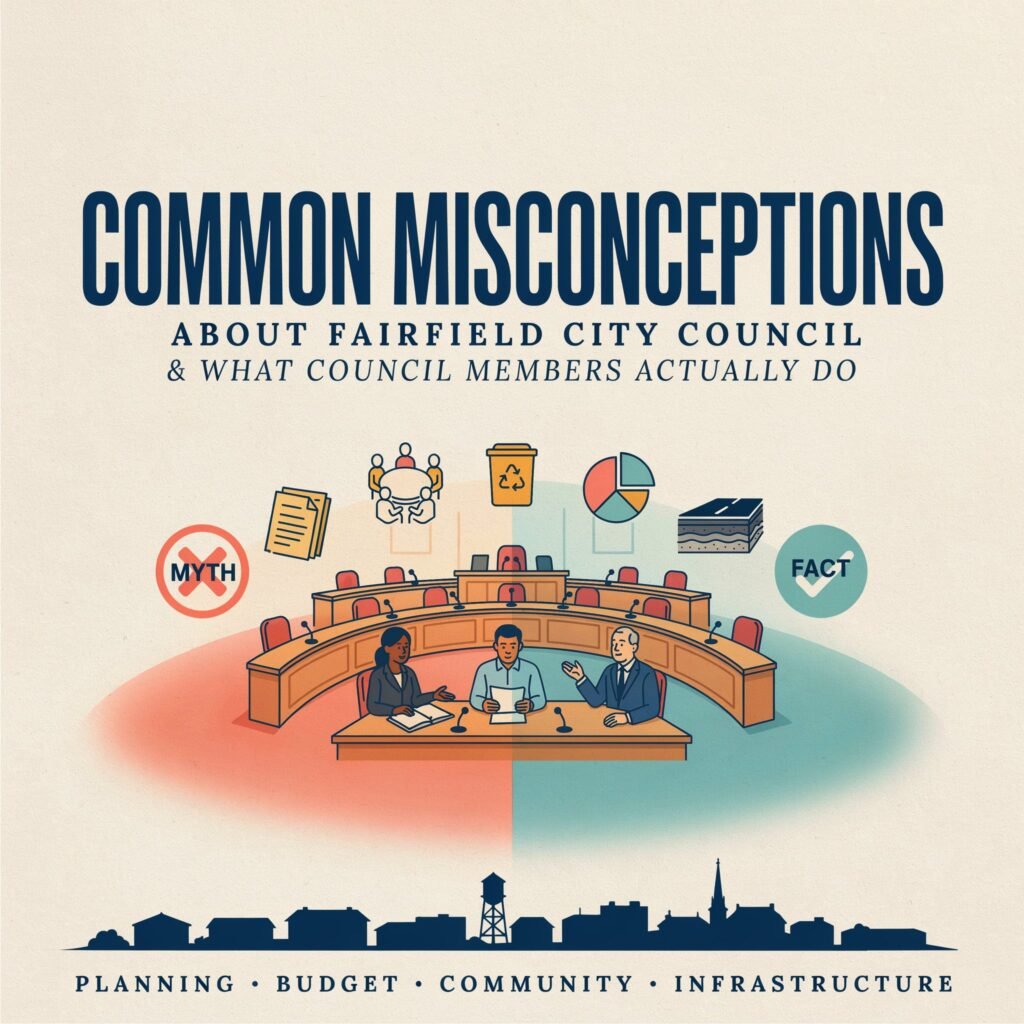
Most people have a vague idea of what a city council does.
Something about local laws. Something about the budget. Maybe potholes. But when you ask someone to explain exactly what their city council member does on a day-to-day basis, the answer usually gets fuzzy fast. And that fuzziness is not the fault of voters. It is the result of local government rarely explaining itself in plain language.
That gap matters, especially heading into November. When voters do not fully understand what a council member’s job actually involves, it becomes harder to evaluate candidates fairly, harder to hold elected officials accountable, and easier for misconceptions to take root.
K. Patrice Williams, who has represented Fairfield’s District 1 since 2022, has spent her first term navigating exactly this gap. Between what residents assume city council does and what the job actually requires day to day. Clearing up that gap is good for democracy. It is also good for evaluating who deserves your vote this November.
Here are the most common misconceptions about Fairfield City Council, and what the job actually looks like.
Misconception 1: “The City Council Runs the Day-to-Day Operations of the City”
This is probably the single biggest misunderstanding about how local government works.
Fairfield operates under a Council-Manager form of government with a separately elected mayor and councilmembers elected to staggered four-year terms. Under this structure, the city council does not run daily operations. That responsibility belongs to a professional city manager.
The council-manager form consists of an elected city council responsible for policymaking, and a professional city manager, appointed by the council, who is responsible for administration. The city manager directs the daily operations of city government, handles personnel functions, and is responsible for preparing the city budget.
Think of it like a corporate board of directors and a CEO. The city council functions as the board of directors, setting direction and policy, while the city manager functions as the CEO, running daily operations and implementing the policies the council establishes.
So when something goes wrong with a specific city service, a pothole that has not been filled, a permit that is taking too long, the council member is not the person physically fixing it. But they are the person responsible for the policies, budget priorities, and oversight that determine whether the departments handling those issues have what they need to do their jobs well.
This distinction matters for K. Patrice Williams Fairfield election conversations specifically, because her effectiveness as a council member is not measured by whether she personally resolves every individual complaint. It is measured by whether her votes, advocacy, and policy priorities create the conditions for city departments to actually deliver for District 1.
Misconception 2: “Council Members Have Individual Power to Make Things Happen”
Here is something that surprises a lot of people. A single council member cannot simply decide something should happen and make it so.
The primary role of the council is to serve as the policy makers for the city, with responsibilities that include adopting local codes and ordinances, approving the budget, and approving contracts. Council members tend to focus on big picture goals such as community growth, sustainability, and economic development.
But policymaking is a collective process. It requires votes and also building consensus among colleagues who may have different priorities. It requires navigating the formal structures of public meetings, agenda items, and procedural rules.
What an individual council member actually has is influence, not unilateral authority. They can advocate and push items onto the agenda. Also, they can build coalitions with other council members. They can use their position to amplify community concerns and bring them into formal policy discussions. But getting something done requires the council as a body to act, plus the city manager and staff to implement it.
This is exactly why a council member’s relationships, communication skills, and ability to build coalitions matter so much. K. Patrice Williams’ approach to governance has consistently emphasized this kind of coalition building, working with colleagues, county officials, and community organizations to move priorities forward rather than relying on any illusion of solo authority.
Misconception 3: “The Mayor Has More Power Than Other Council Members”
This one is rooted in how mayors work in many other forms of government, where a strong mayor system gives the mayor significant executive authority.
Fairfield does not operate that way.
In council-manager communities, the mayor is a voting member of the city council who presides at council meetings, represents the city in intergovernmental relationships, appoints members of citizen advisory boards and commissions with the advice and consent of council, and facilitates communication between elected and appointed officials.
In other words, the mayor has additional ceremonial and procedural responsibilities, but their vote counts the same as any other council member’s vote. Unlike in a strong mayor-council government, the mayor is a regular voting member of city council with little or no legal privileges that distinguish them from other council members.
This matters for how District 1 voters should think about representation. Your council member is not a junior partner to the mayor. They have an equal vote on every policy decision, every budget item, and every ordinance that comes before the council. The influence a council member has comes from their preparation, their relationships, and their ability to make the case for their district’s priorities, not from their proximity to the mayor’s office.
Misconception 4: “City Council Decisions Do Not Really Affect My Daily Life”
This misconception might be the most consequential one, because it directly affects voter turnout.
Council members focus on big picture goals such as community growth, sustainability, and economic development, leaving routine day-to-day issues to the city manager. But “big picture” does not mean distant or abstract. It means the decisions that shape the framework everything else operates within.
Every budget decision affects which neighborhoods get infrastructure investment first. Also, every zoning and land use policy affects what gets built where, and how housing affordability evolves over time. Every ordinance affects what businesses can do, what residents can expect from city services, and how public safety resources get allocated.
The articles in this series, on housing affordability, fiscal discipline, public safety, small business support, infrastructure in Cordelia and Green Valley, environmental sustainability, and disability access, are not separate from city council’s role. They are exactly what city council’s role produces. Every one of those issues traces back to budget votes, policy decisions, and priorities set at the council table.
When people say local elections do not matter as much as national ones, they are usually thinking about visibility, not impact. In terms of actual impact on daily life, local elections often matter more, precisely because of how directly council decisions shape the community you live in every day.
Misconception 5: “City Council Members Have a Lot of Staff and Resources”
Many residents assume their city council member operates with something like a congressional office, staff, a research team, dedicated communications support.
The reality in most council-manager cities is much leaner. Council members typically have limited dedicated staff support, if any, and rely heavily on city staff who serve the entire council and city manager, not any individual member’s agenda.
This means a council member’s effectiveness depends heavily on their own preparation, their own research, their own outreach to constituents, and their own ability to navigate complex policy areas without a large support apparatus. A council member with relevant professional background, legal training, financial literacy, business management experience, walks into that environment with a real advantage, because they are not starting from zero on every complex issue that crosses their desk.
This is part of why K. Patrice Williams’ background matters so directly to how she does this job. Her Juris Doctor and economics training are not just credentials. They are tools she uses without needing a large staff to do the analytical work for her.
Misconception 6: “Council Members Can Override the City Manager or Department Heads”
Under council-manager statutes, the city council is prohibited from interfering with the manager’s administration. The city manager, however, is directly accountable to and can be removed by a majority vote of the council.
This creates an important separation. Council members set policy and approve budgets. They do not direct individual department employees, override department head decisions on operational matters, or manage personnel.
What council members can do is hold the city manager accountable for how policies are implemented, ask hard questions in public meetings about whether departments are meeting council priorities, and use the budget process to redirect resources toward the outcomes residents need.
Research backs up the effectiveness of this separation. A 2011 IBM study of 100 American cities found that council-manager cities were on average 10 percent more efficient than cities with a strong mayor form of government, and a 2019 University of North Carolina study found that corruption was 57 percent less likely in council-manager cities than in cities with other forms of government.
That structure is designed to keep politics out of day-to-day administration. But it also means that a council member’s real power lies in policy, budget, and public accountability, not in administrative control. Understanding that helps voters evaluate candidates more accurately. The question is not whether a candidate will personally fix every operational issue. It is whether they will use their policy and budget authority effectively to create the conditions for those issues to get fixed.
Why This Matters for the K. Patrice Williams Fairfield Election
Understanding what city council members actually do changes how voters should evaluate this November’s election.
It is not about finding a candidate who promises to personally handle every individual problem. That is not how the job works, and any candidate who implies otherwise is either misunderstanding the role or misleading voters.
It is about finding a candidate who understands the policy and budget levers available to a council member, who has the professional background to use those levers effectively, who builds the coalitions necessary to move priorities forward within a collective decision-making body, and who holds the administrative side of city government accountable for delivering on the council’s policy direction.
K. Patrice Williams’ record over the last four years reflects exactly this kind of engagement. Her legal training helps her navigate policy complexity. Her business background informs her budget priorities. In addition, her community relationships help her build the coalitions that turn policy positions into actual votes. And her consistent presence in District 1 means she stays connected to what residents need, even though her formal authority operates at the policy level rather than the day-to-day operational level.
This November, vote for the candidate who understands how this job actually works, and has spent four years doing it well.
Vote K. Patrice Williams for Fairfield City Council, District 1.
Learn more at kpatriceforfairfield.com and connect with K. Patrice Williams on LinkedIn.
Frequently Asked Questions
1. Does the Fairfield City Council run the city’s daily operations?
No. Fairfield operates under a council-manager government, where the council sets policy and budget priorities while a professional city manager handles daily operations.
2. Can one city council member make changes on their own?
No. Council members influence policy through advocacy, coalition building, and votes, but actual policy change requires a majority vote of the full council.
3. Does the mayor have more authority than other council members?
No. In Fairfield’s council-manager system, the mayor has additional procedural duties but holds the same single vote as every other council member.
4. How do city council decisions actually affect residents?
Through budget allocations, zoning and land use policy, ordinances, and oversight that shape housing, infrastructure, public safety, and economic development across every district.
5. What makes a city council member effective within this system?
A strong understanding of policy and budget processes, relevant professional experience, the ability to build consensus with colleagues, and consistent follow-through on holding city administration accountable.